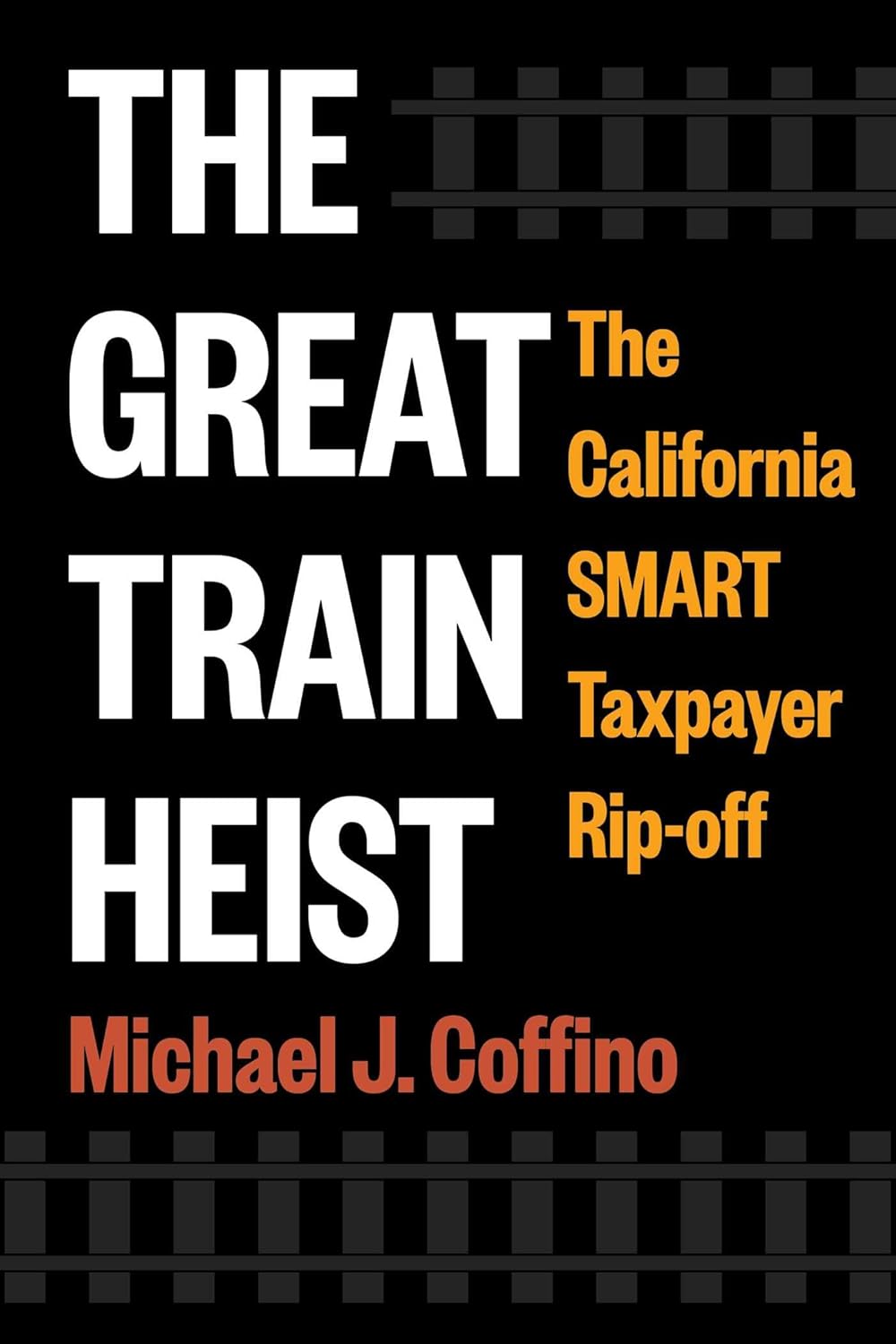
The Great Train Heist: The California SMART Taxpayer Ripoff
In The Great Train Heist: The California SMART Taxpayer Ripoff, Michael J. Coffino examines how the Sonoma–Marin Area Rail Transit (SMART) train became one of the most consequential public-spending failures in modern California history. Drawing on internal records, public filings, voter materials, and independent research, Coffino traces a pattern of financial mismanagement, misleading campaign promises, weak oversight, and entrenched conflicts of interest that allowed the project to advance despite glaring warning signs. What began as a promise of regional mobility and environmental progress instead evolved into a system defined by chronic cost overruns, inflated ridership projections, zero impact on traffic congestion, imaginary environmental benefits, and a persistent lack of public transparency.
After consuming more than $1 billion in taxpayer funds, SMART carries fewer than 3,000 riders per day, a substantial portion of which ride for free, while requiring taxed-based subsidies for roughly 94 percent of its operating costs, placing it among the most expensive transit systems in the nation on a per-passenger basis. Coffino shows how Pollyannish assumptions displaced rigorous objective analysis, how dissenting voices were ostracized, and how accountability mechanisms failed at nearly every stage of planning and execution. The result is a rail system that disproportionately serves affluent riders while shifting the financial burden onto working families who may never set foot on the train.
With SMART’s sales-tax funding sunsets in 2029, The Great Train Heist arrives at a pivotal moment. More than a critique of a single project, the book is a cautionary study of what happens when misguided intentions and self-interest meet unlimited budgets and minimal scrutiny. Essential reading for anyone concerned with government accountability, transportation policy, or California politics, it challenges readers to reconsider how public infrastructure decisions are made—and who ultimately pays the price when they go wrong.

Book Awards